
The audience has changed faster than the film business


Last week at Finnish Film Affair and Nordic Genre Lab in Helsinki, one thought kept coming back: The audience has changed faster than the film business.
A lot of the way films are financed and distributed is still based on systems built decades ago. Theatrical windows, home video, pay TV, free TV and then streaming. Some of those are still working, some are shrinking, and some seem to be going full circle.
Meanwhile, audiences have moved on much faster.
The younger audience is digital, global and pretty much platform agnostic. Korean horror, Japanese anime, Finnish games, European genre films and US series can all live in the same feed. Something that might have taken weeks to travel in the past can now spread around the world instantly.
That gap between the old structures and current audience behaviour came up again and again at FFA. In discussions about funding, festivals, distribution, genre, social media and finding audiences.


Streaming starts to look a lot like television
One of the best sessions was Nordic Genre Lab’s The Market Is The Monster, with Claire Willats, Todd Brown, Camille Gatin, Roar Uthaug and Hanna Bergholm.
The title was accurate.
One of the themes was how we went from the home video years, through the huge expansion of streaming, to the situation we are in now: trying to find a new normal.
And I’m not sure anyone knows exactly what that new normal is yet.
Streaming was largely built around SVOD. You paid your subscription, there were no ads, and platforms argued that it was difficult to say how much revenue one particular film or series generated. That also affected how talent was paid. Now the same platforms are moving heavily towards advertising.
Suddenly streaming starts to look a lot more like the old broadcaster model. More viewers mean more advertising inventory and more value. But many of the talent agreements were created for the subscription model.
Todd Brown’s point was simple: if successful content is now clearly generating advertising revenue, it becomes harder to argue that the people who created it should not participate more directly in that success.
The guild agreements are already moving somewhat in this direction with viewership bonuses and improved streaming residuals, but there is still a pretty obvious tension between AVOD revenue and how talent participates in it.
Todd sees this as one of the issues likely to become increasingly important in future talent negotiations.

What does direct-to-consumer actually mean?
We use “direct-to-consumer” quite casually, but there is a big difference between reaching an audience directly and actually doing business with them directly.
If a producer builds 100,000 followers, creates TikTok clips, runs a Discord community and gets people excited about a film, but all the actual revenue eventually goes through somebody else, that is mostly marketing. Very good marketing, perhaps, but still marketing.
DTC gets more interesting when some of the money can also flow directly back to the producer, IP owner, investors and talent.
That could be direct rentals, premium access, memberships, special screenings, collector products, fan investment, merchandise or other things we probably haven’t properly figured out yet.
The key question is: Can some of the revenue generated by that audience also come back directly to the people who created and financed the IP?
Build the first audience. Prove there is demand. Create some direct revenue. Then work with partners who can take that demand much further internationally.
But if creators and producers are expected to build audiences themselves, there also needs to be a business model behind that work. Otherwise we are just doing free promotion further up somebody else’s value chain.
Build the cult, then the crowd
This linked directly to Samuli Kyttälä’s NGL masterclass How to Create Buzz on Social Media. One of the ideas I liked most was: Build the cult. The cult brings the crowd.
For an independent genre film, you don’t need everybody at first. You need the right few people. Programmers, critics, genre fans, creators and early adopters who genuinely want to talk about the film and pass it on.
Samuli’s model also makes an important distinction between the filmmaker’s job and the distributor’s job. Filmmakers can start building that early group, while distributors and platforms have the reach and resources to grow it much further.
Buzz without a place to watch dies.
Going viral is not a distribution strategy. If somebody gets excited about your film and then can’t watch, buy, rent or attend it, you have probably lost the moment.
Squid Game is an obvious extreme example of how quickly things can now move. Netflix initially focused heavily on Korea rather than planning it as an instant worldwide phenomenon. Once the audience started spreading internationally, the platform could see what was happening and amplify it.
Horror, anime, sci-fi, fantasy and games already have active communities that discover things across borders. They don’t particularly care whether something was made in Finland, Korea, Japan or the US if it connects with them.

Echo Chamber at Nordic Genre Lab
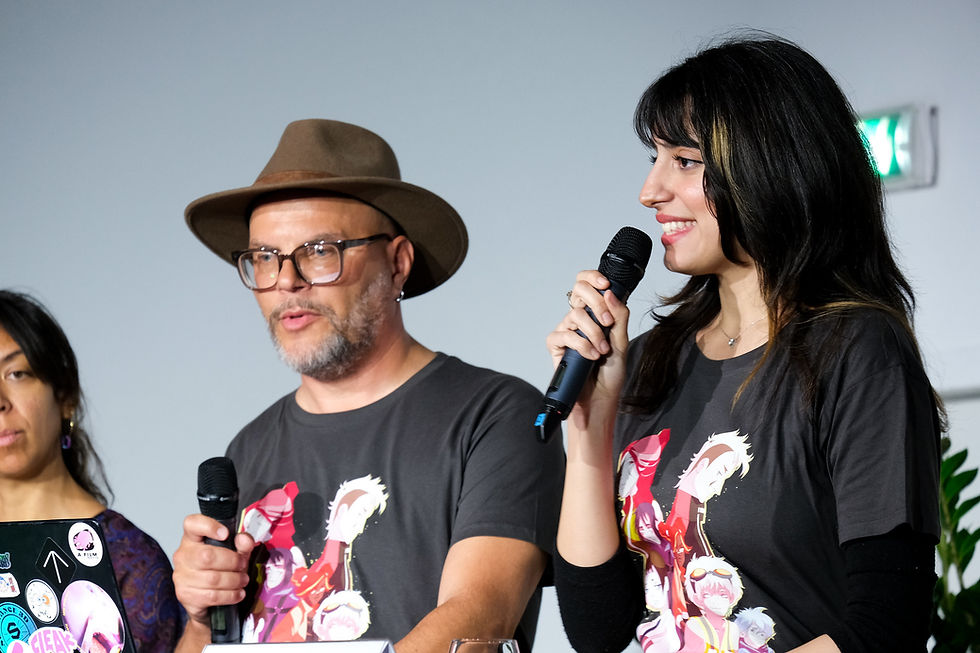
Debbie Stephens and I were at FFA with Echo Chamber, our animated Nordic survival horror feature. It was one of eight projects selected for the first Nordic Genre Lab, bringing together genre films from Finland, Sweden, Norway, Denmark and the Faroe Islands.
Before pitching we had project sessions with Todd Brown and Claire Willats.
Todd brings decades of experience in international genre cinema, including his years at XYZ Films, while Claire has worked across production, distribution, acquisitions and commissioning, including Netflix, Universal and Film4.
What I liked was that the discussions weren’t only script notes, but about the film as a whole: What exactly are we making? Who is it for? Where does it sit internationally? What makes it different? What do sales agents and distributors actually need to understand about it?
Those sound like simple questions. They aren’t. A huge thanks to Todd and Claire for being generous but also very direct with the projects, and to Laura Laaksonen, who managed to run a very intense programme while keeping the whole Lab relaxed, friendly and supportive.

The pitch
Thursday was our pitch day. The Fiction in Development and Nordic Genre Lab sessions filled Bio Rex, and Debbie and I got five minutes to put Echo Chamber in front of a Finnish and international industry audience and the reaction to the pitch and our mood test video was great.
Things moved very quickly from pitching to business: during the afternoon we met Nordic Genre Lab’s international experts from Searchlight, Artemis Fund, Altitude, Logical Pictures, B-Rated Films and Goodfellas, alongside several own meetings with other sales, financing and distribution companies.
That is probably the biggest value of these events. The pitch gets people interested.
The meeting afterwards tells you what they actually think. And the weeks after the event tell you whether something real starts moving.

It was also very nice to see Echo Chamber included in Variety’s coverage of Finnish Film Affair and Nordic Genre Lab.
Variety article:https://variety.com/2026/film/global/finnish-film-affair-nordic-genre-lab-1236872579/
Echo Chamber at Finnish Film Affair:https://hiffindustry.fi/projects/echo-chamber/
Maybe being more Nordic helps
Nordic stories don’t need to become less Nordic to travel. Maybe the opposite.
When audiences are global, specificity becomes interesting.
Snow, darkness, strange local mythology, a Finnish landscape or a visual language people haven’t seen before can be part of the attraction.
The question is how to connect that specificity with the right audience.
This is also why I keep coming back to what we call a World First approach at Fiilin Good Films.
Audience and IP strategy shouldn’t start six weeks before release. A story world can start living through a film, graphic novel, short-form work, a game, artwork or community much earlier. Each format can do something different rather than simply advertise the next one.
But the commercial side matters too. If we build an audience around an IP early, some of that value should eventually support the people making and financing it. Otherwise audience-building risks becoming just another cost for the producer. I don’t think we have all the answers yet.
But these are exactly the conversations I want to be having.

Three very full days
FFA itself was packed. Alongside the pitches and meetings there were sessions on European funding, festival programming, audience development and distribution, followed by the genre panel and an XYZ Films / Film Tampere masterclass looking at how the Norwegian The Trip became a Hollywood remake shot in Finland.
And, because this was Finland, there was also dinner and sauna at Löyly by the Baltic Sea.
Nordic Genre Lab finally wrapped on Friday evening with closing drinks at Kino K13 at the Finnish Film Foundation, after three days that somehow managed to combine quite serious industry conversations with a lot of laughter.


I came away tired, but also energised.
The business is going through a difficult transition.
Financing is harder. Distribution is changing. Streaming is changing. Audience behaviour is changing even faster. But people haven’t stopped wanting films and stories.
The interesting part now is figuring out how the economics catch up with the audience, and how more of the value created by successful stories can make its way back to the people who created, financed and own them.
For Echo Chamber, Finnish Film Affair and Nordic Genre Lab felt like a very good step in that direction.
Now for the follow-ups.
Thanks also to the Nordic Genre Lab jury and industry experts, Finnish Film Affair / HIFF, Finnish Film Foundation, Nordisk Film & TV Fond, Nordisk Kulturfond, Samuli Kyttälä / PURR PR, Fireframe and everyone who shared feedback, contacts and ideas with us during the week.
Nordic Genre Lab:https://nordicgenrelab.org/
Finnish Film Affair:https://hiffindustry.fi/


Comments