
AV Growth: Tools for a Changing Media Landscape


When Fiilin Good Films joined AV Growth in autumn 2024, we were not looking for one simple answer to growth.
Like many independent audiovisual companies, we already had projects, partners, experience, ambition and many moving pieces. What we needed was a better map.
The audiovisual landscape keeps changing. Film, television, animation, games, publishing, digital platforms, AI, Web3, crowdfunding, private investment and international co-production are no longer separate conversations. They increasingly affect each other. For a boutique IP company, that can be exciting, but also difficult to navigate.
Looking back at the six AV Growth workshops:
AV Growth gave us better tools to understand where the industry is moving, better questions to ask about our own company, and a stronger Nordic-Baltic network of people and companies trying to solve similar problems from different angles.
Workshop 1: clarity before acceleration
Tampere, October 2024
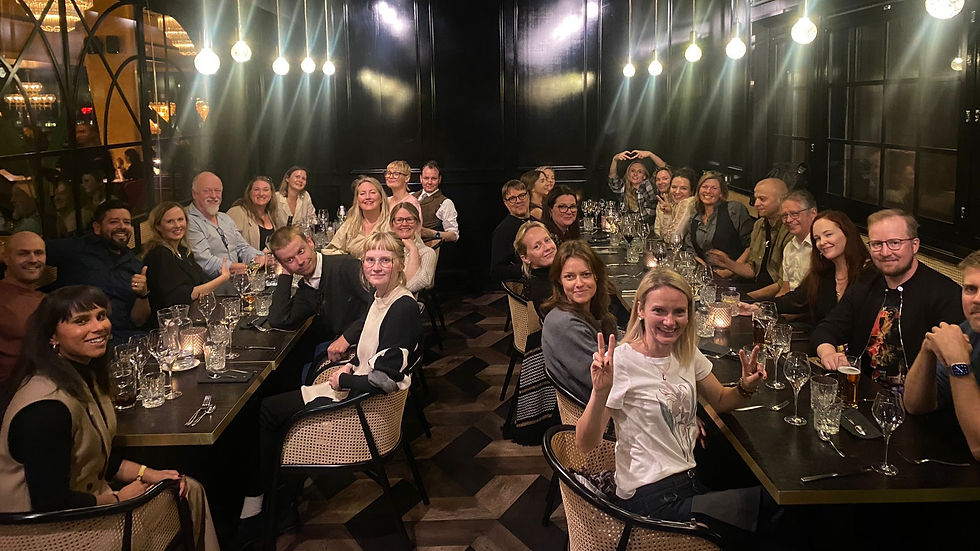
The first workshop in Tampere started with a useful principle: before a company can grow, it needs to understand where it actually is.
Hanna Vuorinen from Media Minds introduced the business maturity ladder and the idea that companies move through different stages. Not every company has the same problem. Some need basic structures. Some need repeatable processes. Some need a clearer sales strategy. Some need stronger international partnerships, better data, or a more systematic way to turn projects into long-term business.
This was a good starting point because AV companies often carry many roles at once. We develop, produce, finance, pitch, sell, market, manage talent, build partnerships and sometimes try to invent the future on the side. It is easy to confuse movement with progress.
Marko Kulmala from Insano added another important layer: strategic storytelling. How does a company explain itself clearly, not only through individual projects, but through a larger purpose, direction and culture?
For FGF, this was not about discovering who we are from zero. We came into AV Growth with a strong slate, released work, international development and a clear interest in original IP. But the first workshop helped frame the question more sharply:
What do we do repeatedly?
What can we build on?
Which parts of the company need more structure?
Who do we need around us to move forward in a more sustainable way?
These became a recurring themes throughout the programme.
Workshop 2: IP, games and investor logic
Gothenburg, January 2025

The second workshop in Gothenburg moved the conversation directly into IP, games, licensing and investment.
This was especially relevant for FGF, because our work increasingly sits between animation, games, graphic novels, webtoons, publishing and digital-first formats. The question is not simply whether a film can become a game, or whether a game can become a series. The harder question is: when does that make sense?
Natasha Skult from MiTale gave a practical and very clear view of IP opportunities in games. One of the useful takeaways was that games are not just another screen for the same story. They work differently. Player agency, worldbuilding, interaction, community, platform choice, production pipeline and genre all matter.
The advice to “pick your battles” stayed with me. Not every IP should become everything. A good transmedia strategy is not about spreading a project randomly across formats. It is about understanding what each format can do, who it reaches, and whether it genuinely adds value.
Thierry Baujard brought the investor and financing perspective through Media Deals, with the added context of his work with SpielFabrique. That combination was useful because the discussion did not stay inside traditional film financing. It also connected to games, publishers, private investors, business models and the challenge of making creative value legible to capital.
A key lesson from this workshop was that creative industries often operate between two worlds: project financing and company investment. Public funding, subsidies and co-production are familiar tools for many AV companies. Private investment asks different questions.
Why is this a business?
Who is the customer?
Where is the market?
What makes it scalable?
What is the return logic?
What protects the value?
These are not always comfortable questions for creative companies, but they are necessary ones.
Workshop 3: responsibility, AI and rights in a changing tool landscape
Malmö, May 2025

The third workshop in Malmö widened the frame. Growth was no longer only about financing, partnerships or market access. It was also about responsibility.
The sessions touched on sustainability, responsible business, AI, legal risks, copyright, data, ownership and new markets. This was a useful reminder that new tools do not remove old responsibilities. In many cases, they make them more complicated.
For FGF, this was particularly relevant because we are exploring AI-assisted workflows, animation pipelines, game development and digital IP production. There is real potential in new tools, but there are also serious questions around rights, consent, training data, copyright, authorship and contracts.
The practical lesson was simple: do not adopt technology just because it is available. Understand what it changes.
Who owns the output?
What material was used to create it?
Can the work be protected?
What does the contract actually say?
How does the technology affect artists, partners and the long-term value of the IP?
That kind of caution is not anti-innovation. It is part of sustainable innovation.
Workshop 4: pitching, sales and numbers
Helsinki, September 2025

The fourth workshop in Helsinki brought the conversation back to communication.
Elsa Ervasti focused on pitch structure, presentation and clarity. A useful pitch is not just a compressed version of everything you know. It has to create understanding quickly. It needs a goal, a clear listener, a point of view and enough emotional connection for people to care.
Outi Stüber worked on sales and customer relations. In the AV sector, “sales” can still feel like a slightly uncomfortable word. But in practice, much of the work depends on relationships, negotiation, timing, listening and understanding what the other side actually needs.
Essi Hellén from Storytel opened another useful perspective: the wider business potential of IP. Stories can move through audio, books, podcasts, adaptations, add-on series and other formats. Again, the point is not to expand everything everywhere. The point is to ask whether the idea has reached its full potential, and which formats genuinely serve the audience.
FrameSage then brought in the numbers. Their “pitching with numbers” approach was a good reminder that artistic vision, audience, marketing and investor logic should not be separated. If you want someone to invest, support or partner with a project, they need to understand not only the story, but the audience, the route to market and the financial logic.
The Helsinki workshop also had an important social and professional dimension. The afterwork visits and drinks at Return Entertainment with Anna Rosa Lappalainen, and at Helsinki Casting & Blockbusters Gang, helped turn the programme from a workshop series into a real network.
Seeing where other companies work, how they think and what they are building matters.
Trust is not built only in lecture rooms.
Workshop 5: crowdfunding, Creative Angels and Web3
Gothenburg, January 2026

The fifth workshop in Gothenburg connected community, funding and new digital ownership models.
The crowdfunding session with Milja Inkeri Mäkelä from FiBAN was particularly useful because it was honest. Crowdfunding is not easy money. It requires an audience, a clear reason to act, a realistic target, campaign resources and a lot of communication before, during and after the campaign.
FGF has learned some of these lessons already through previous crowdfunding work. That experience is useful now as we look towards possible new campaigns. Crowdfunding can be a financing tool, but it can also be validation, pre-marketing, proof of demand and a way to build a closer relationship with an audience.
It is also easy to underestimate the work. A campaign does not begin on launch day. By then, much of the real work should already be done.
The Creative Angels and FiBAN perspective added another layer. Angel investors are not patrons. They are not donors. They may care about culture, creativity and impact, but they are still investors. They look for trust, a clear case, a strong team, proof of concept, scalability and a route to value.
This matters for creative companies because we often communicate very well to audiences, broadcasters, public funders and creative partners, but not always to private investors. Those conversations require a different language.
Workshop 5 also introduced Web3 and blockchain from a fan, community and campaign perspective, through Alexander Bitskov and ZenFrogs. The useful part was not the hype around NFTs. It was the practical question underneath:
What sits between the creator and the audience?
What assets already exist around a project that fans might value?
Could a digital asset, fan pass or “digital toy” help fund, validate or build a community around an IP?
And how do we do that without giving away rights we should protect?
For a company like FGF, which develops original IP across animation, games, graphic novels, webtoons, publishing and digital formats, these questions are very relevant. Web3 is not a strategy by itself. But blockchain technology, digital ownership and programmable access can become part of a wider IP strategy if they are used carefully.
Workshop 6: rights, infrastructure and the network becoming real
Tampere, May 2026

The final workshop in Tampere brought many of the earlier themes together.
Marko Kulmala returned to the question of strategic storytelling. Fanny Heinonen led the reflection on what had been learned and where to go next. There was also a mindfulness moment in the park after a very dense and quite heavy seminar session, which honestly felt like exactly the right thing at the right time.
Then Cyon Media brought Web3 back into the conversation from another angle.
This was a useful continuation from Workshop 5. In Gothenburg, Web3 had been discussed more through fans, communities, digital assets and campaign logic. In Tampere, Cyon Media focused more on infrastructure: rights, licensing, analytics, payment rails, access and monetisation.
Their line stayed with me:
“The infrastructure exists. The question is whether your IP is in it.”
That is a strong question for the whole AV sector.
For decades, content companies have often had to choose between reach and control. Traditional distribution still matters, of course. Broadcasters, platforms, publishers, sales agents and distributors are not disappearing. But as digital infrastructure changes, creators and IP owners need to understand more clearly where their rights live, how they are tracked, and how value flows back.
For FGF, this connects directly to our long-term strategy. We are not interested in Web3 or blockchain as buzzwords. We are interested in the practical possibilities around protecting, licensing, distributing and monetising original IP in smarter ways.
The final workshop also included FiBAN Pitch Finland and investor networking. For FGF, this was a useful pressure test. It forced us to explain the company and slate in a clearer investor language, without losing the creative core.
And then the programme ended in a very Finnish way: on a sauna boat.
There was a slightly haikea feeling when it was over. But also a good feeling. New friends, new colleagues, and a stronger Nordic-Baltic AV network.

The value of the network
One of the best things about AV Growth was that the participants did not all come from the same corner of the industry.
There were companies from film, TV, games, XR, animation, casting, production, digital platforms and hybrid models. That mix made the conversations more useful. A film producer and a game studio may use different words, but often they are trying to solve related problems: financing, audience, talent, IP, distribution, visibility and time.
Through the programme, FGF has built and deepened conversations with many companies and people across the network, including AiAiProductions / Jarkko Jortikka / AiAi and High Mountain Rangers, Europa Films / Giulio Musi, Media Deals and SpielFabrique / Thierry Baujard, MiTale / Natasha Skult, RedStage Entertainment / Marjaana Auranen, Dreamloop Games / Joni Lappalainen and Rory Warwick, Jamedia Productions / Anna Blom and Mia Palmgren, Sunday Rebel Films/ Kristele Pudane, Tallifornia / Tonu Hiielaid, Return Entertainment / Anna Rosa Lappalainen, and Helsinki Casting / Katri Aksola.
Some of these conversations may become collaborations. Some may become advice, introductions, shared market knowledge or simply better understanding of how others are navigating the same changing landscape. That is also valuable.
What we take forward
For Fiilin Good Films, the main takeaway from AV Growth is not a single tool, one workshop or one contact. It is a better way to think.
Growth in the AV sector is not only about getting bigger. It is about becoming more deliberate. More structured. More aware of the market. More capable of explaining value to different people. More careful with rights. More open to collaboration. More realistic about funding. More curious about new technologies without being naïve about them.
AV Growth helped us understand the media landscape better as it keeps changing.
It also reminded us that expertise does not only come from speakers on stage. It comes from peer companies, mentors, late conversations, office visits, difficult questions, shared frustrations and practical examples.
A warm thank you to the organisers and mentors who made this possible: Fanny Heinonen, Niina Virtanen and Arto Käyhkö from Film Tampere; Juha Suonpää, Maria Salomaa and Ilmari Huttu-Hiltunen from Tampere University of Applied Sciences; and Charlotte Gimfalk from Yrkesnämnden för Film och TV.
Thank you also to the programme mentors and experts, including Hanna Vuorinen / Media Minds, Marko Kulmala / Insano, Natasha Skult / MiTale and University of Turku, Emma Ilves / Helsinki Casting & Blockbusters Gang, Roosa Toivonen / Ikigai, Marika Makaroff / Gutsy Animations, Arto Käyhkö / Film Tampere, Martina Eriksdotter / AI Sweden, Grace Maharaj / Arvet Agency, Emmanuel Eckert, Justine Bannister / Just B Consulting, Thierry Baujard / Media Deals, Jacqueline Gault / The Gault Shop, and Lene Børglum / Space Rocket Nation.
And thank you to all the participating companies, what a great new network.

Comments